

China Intellectual Property Annual Conference · ACIP Highlights
2026-09-11 15:51
From 2010 to2026, from building an international exchange platform for patent informationto expanding its agenda into fields such as trademarks and geographicalindications, the China Intellectual Property Annual Conference (CIPAC) hasdelivered fifteen outstanding editions to IP practitioners. With its authority,forward-looking vision, professionalism and international character, it ishailed as the bellwether of China's intellectual property field.
In 2026,ACIP participated deeply in the 15th China Intellectual Property AnnualConference (CIPAC) and invited distinguished guests from Huawei, CATL, theChina State Shipbuilding Corporation Comprehensive Technology and EconomyResearch Institute, Hisense, Xiaomi Auto, Haier, the Jiangsu SemiconductorIndustry Association and Hangzhou Haicun, to jointly explore the theme "GoingGlobal — Building Industrial IP Systems and the Practical Operation of GlobalPatent Assets" from the perspectives of enterprises, researchinstitutes and industry associations.
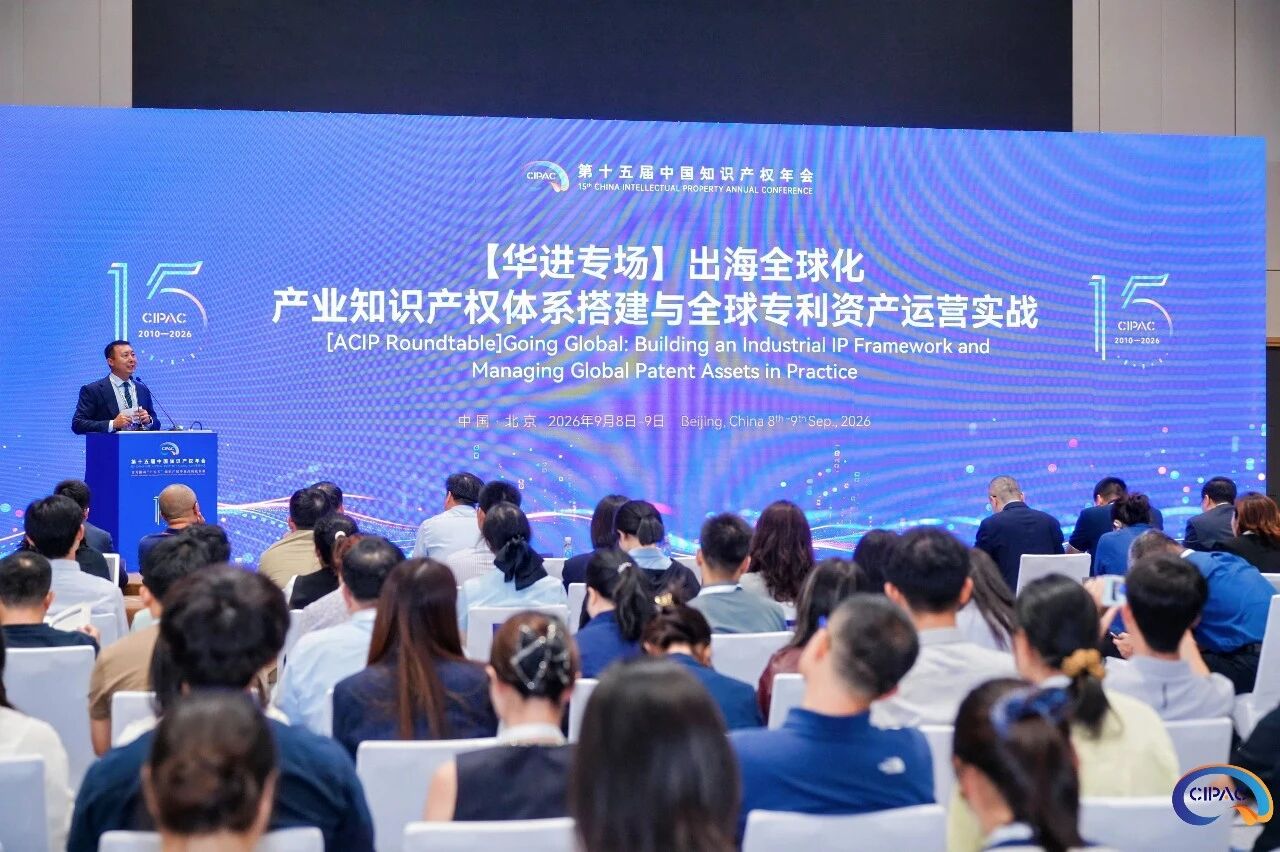
Roundtable Session · ACIP Special Session
Going Global — Building Industrial IP Systems and thePractical Operation of Global Patent Assets
On theafternoon of September 8, 2026, the ACIP special roundtable was successfullyheld at Phase II of the China National Convention Center in Beijing. It heldin-depth discussions on core topics such as overseas risk prevention andcontrol, the building of globalized IP systems, practical responses to SEPs,and the commercial operation of patent assets, presenting the audience with anindustry feast blending ideas and practice. Mr. Zhao Yonghui, Chairman ofHangzhou High-Tech IP Operation Co., Ltd., served as the moderator.
Keynote Sharing 1: FTO Risk Control and Front-LoadedPatent Risk Governance for New Energy Vehicle Exports
Speaker: Dong Ke, Head of Patents, Xiaomi Auto
In hissharing, Dong Ke systematically outlined the types of IP risks enterprises facewhen going global, covering six major scenarios including patent infringementrisk, trademark and domain-name squatting, and trade secret leakage. Heemphasized that because the vehicle development cycle is long, IP riskmanagement must be embedded into the entire process — for example, from"directional" patent navigation at the mid- to long-term technologyplanning stage, to "pathway" analysis at the strategic developmentstage, and then to "specific risk screening" at the technicalsolution lock-in stage, advancing layer by layer in a tightly interlockingmanner. He particularly noted that supplier management is a key link in exportrisk control for complete vehicles: OEMs need to establish a tiered andcategorized supplier management system, with particular attention to theoverseas rights-holder risks that domestic-substitution suppliers may face.
Keynote Sharing 2: How IP Integrates into the GlobalIndustrial Division of Labor — Global IP Practice in the Semiconductor Industry
Speaker: Wang Weiming, Senior IP Consultant, JiangsuSemiconductor Industry Association
As a veteranexpert with more than 40 years of deep experience in the semiconductorindustry, Wang Weiming reviewed the growth journey of China's semiconductorsector — from introduction and absorption, to domestic substitution, and thento technological overtaking. He shared observations on cases such as AMEC's winagainst international giants in the etching equipment field through independentinnovation, and Yangtze Memory's outbound cross-licensing of patents. Hepointed out that moving from domestic substitution to IP going global is notsimply capacity substitution, but technology substitution and patentsubstitution, and that Chinese enterprises must dare to take the initiative onthe IP battlefield.
Roundtable Dialogue 1: How to Build an EnterpriseOverseas IP System Adapted to the Industrial Division of Labor
Speakers:
l Dong Ke — Head of Patents, Xiaomi Auto
l Wang Weiming — Senior IP Consultant, Jiangsu Semiconductor IndustryAssociation
l Liu Yiyin — Director of the IP Department, Hisense Group
l Yao Yuanda — Director of the Patent Division, IP ManagementDepartment, CATL
l Zhong Xin — Technical Director (Senior Expert), IP and AchievementManagement Research Center, Comprehensive Technology and Economy ResearchInstitute, China State Shipbuilding Corporation
In theroundtable sharing, Dong Ke, drawing on the characteristics of the new energyvehicle industry's long supply chain and multi-tier suppliers, proposed thatthe core of an overseas IP system lies in layered management and front-loadedembedding. Wang Weiming, based on the semiconductor industry's high technicalbarriers and dense patent landscape, noted that an IP system adapted to theindustrial division of labor depends first and foremost on interdisciplinarytalent rooted in the industry, and proposed a growth path of "understandthe industry first, then learn the law." Liu Yiyin stated that whatsupports an enterprise in calmly handling overseas disputes is not scatteredtactics but a systematic capability covering the entire chain of portfoliolayout, risk control and operation — patents should value quality overquantity, and one must dare to confront opponents head-on in overseas courts.Yao Yuanda held that IP teams must break down the language barriers betweentechnology and business and deeply embed patent strategy into R&D andbusiness decision-making, so as to achieve the leap from risk prevention tobusiness empowerment. From the perspective of the shipbuilding industry, ZhongXin pointed out that although patent disputes in the shipbuilding sector arerelatively few, patent filings by countries such as South Korea, Spain andNorway have been growing rapidly in recent years. Building an industry-adaptedIP system must first resolve the organizational question of "who does itand how it is done." The shipbuilding industry needs to plan ahead ingreen and intelligent technologies to meet the coming wave of patentcompetition.
Keynote Sharing 3: Evolution of Global SEP Rules and PracticalResponses for Chinese Enterprises
Speaker: Xu Bo, Director of the Consulting BusinessDivision, ACIP
Do Chinese enterprises want to be price-setters of therules, or merely price-takers?
Today,standard essential patents (SEPs) have long transcended the purely IP domainand evolved into an institutional battleground for global technologicalcompetition, industrial security and rule-making contention. The global SEPgame unfolds along three main lines:
l The contest over who sets global royalty rates
l The offense and defense around injunctions and FRAND defenses
l The game over licensing targets and licensing levels
In a dynamicanalysis by jurisdiction, Xu Bo systematically reviewed the latest developmentsin key jurisdictions including China, the UK, the EU/Germany, Brazil, India andJapan — from institutional breakthroughs in Chinese courts' global rate-settingrulings and anti-suit injunctions, to the creation and setbacks of the UK'sinterim licensing mechanism; from the deterrence of UPC injunctions and theUK-Germany judicial contest over anti-interim-licence injunctions (AILI), to USdiscovery practices and the shift in US SEP policy; and then to Brazil's"preliminary injunction leverage" and Japan's export of rules throughjudicial mediation procedures, as well as the localization-protection tendencyof India's competition regulator. On the methodology for determining FRANDrates, Xu Bo introduced two mainstream approaches on which global courts areconverging: the top-down method, which is good at controlling cumulative ratesbut is relatively subjective; and the comparable licenses method, which isbased on real market transactions but where high-quality comparable agreementsare scarce. He particularly warned that the business risks posed by SEPlitigation itself — including loss of market share, supply chain disruption anddamage to brand reputation — often far exceed the royalty figures themselves.
Facing themultipolar game over global SEP rules, Xu Bo advised Chinese enterprises toadhere to long-termism and build a dual-wheel strategic framework of"defense + offense." On the defense side, enterprises should deployin advance nine major toolkits — including negotiation compliance, invalidationchallenges, litigation countermeasures, design-around and licensing decisionassessments, and diversified dispute resolution — so that full contingencyplans give them the initiative in the game. On the offense side, enterprisesshould complete the leap from "passive payer" to "rule participant,"building long-term competitive barriers through high-quality SEP assetportfolios and a stronger voice in standards organizations.
Keynote Sharing 4: The Complete Path of IPCommercialization and Operation
Speaker: Gao Liang, Director of the Northern ResearchInstitute Division, IP Department, Huawei Technologies Co., Ltd.
Regardingthe path of IP commercialization and operation, Gao Liang introduced Huawei'smodel of "bilateral licensing + patent pool licensing" — that is,reaching a large number of patent licensing agreements through bilateralnegotiations while actively participating in mainstream international patentpools such as Sisvel, Avanci and Access Advance, to share technologicalachievements through one-stop licensing. He emphasized that the positive-cyclelogic of IP operation lies in "R&D — patents — licensing — returns —reinvestment in R&D," with licensing revenue feeding back into R&Dto drive continuous innovation. He also noted that the value of patent operationis reflected not only in licensing fee revenue, but also in safeguardingproduct distinctiveness and maintaining market competitiveness through patentprotection. Huawei respects the IP of others and actively protects its own IP,promoting win-win industrial cooperation through transparent licensing programsand globalized operations.
Roundtable Dialogue 2: Commercial Operation of PatentAssets — Cross-Border Licensing, Asset Transfer and Compliance Monetization
Speakers:
l Xu Bo — Director of the Consulting Business Division, ACIP
l Gao Liang — Director of the Northern Research Institute Division, IPDepartment, Huawei Technologies Co., Ltd.
l Wang Binhou — Director of Standards and Patents, Haier Group
l Zhang Guobiao — Professor, National Excellence Engineer School, SouthernUniversity of Science and Technology; Founder of Hangzhou Haicun InformationTechnology Co., Ltd.
In theroundtable sharing, Xu Bo said that professional institutions should work tobreak through bottlenecks and play the role of "translator" among thefour languages of technology, law, business and finance, bridging the"credit gap" among them to advance the commercial operation of patentassets. Gao Liang responded to the question of patent value, noting that thevalue of a patent should not differ according to the identity of its holder;the core bottleneck in China's patent operation market is that respect forpatent value has yet to become a universal consensus, and IP professionalsshould promote the establishment of a business closed loop of "respect forvalue — reasonable returns — continuous innovation." Wang Binhou arguedthat the operation of Chinese patent pools cannot simply copy foreign models,but should be rooted in the original aspiration of "empowering industrialdevelopment." The smart home IoT industry patents jointly operated by theQingdao National Smart Home Industry IP Operation Center and the HangzhouNational Intelligent Connected Vehicle Industry IP Operation Center balance theinterests of innovators and implementers through an inclusive "developfirst, pay later" mechanism, making patents a genuine bond of cooperationin the smart home IoT industrial ecosystem and jointly advancing industrialinnovation through the mutual benefit of patented innovative technologies.Zhang Guobiao stated that SMEs and academic institutions, on the one hand, andlarge enterprises, on the other, each have their own strengths and differentpositioning in innovation. Large enterprises are better at engineeringimplementation and generate a large number of engineering patents duringproduct manufacturing. SMEs and academic institutions have more flexibletechnology directions and should focus on "groundbreaking" disruptivetechnology exploration, leading the industry by 5-10 years and generatingfoundational, original patents. When large enterprises use the foundationaloriginal patents of SMEs and academic institutions, that value should bereflected — after all, China's chip industry still faces a severe internationalsituation, and large enterprises and SMEs and academic institutions need tojointly build a healthy patent ecosystem.
From FTOrisk screening for new energy vehicles to the domestic-substitutionbreakthrough of the semiconductor industry; from Hisense's experience inoverseas litigation to Huawei's positive cycle of patent operation; from themultipolar game over global SEP rules to the localized exploration of Chinesepatent pools — the ACIP special roundtable brought together the frontierpractical wisdom of Chinese enterprises going global.
Today,Chinese enterprises need to "burn away" the old notion of treating IPmerely as an exclusive weapon, and instead develop its inclusive value, makingIP a bridge for cooperation with global partners. Moving from "riskdefense" to "cooperation and win-win" is not only an inevitablepath for enterprises going global, but also a proposition of the times forChina's IP cause to move toward high-quality development.
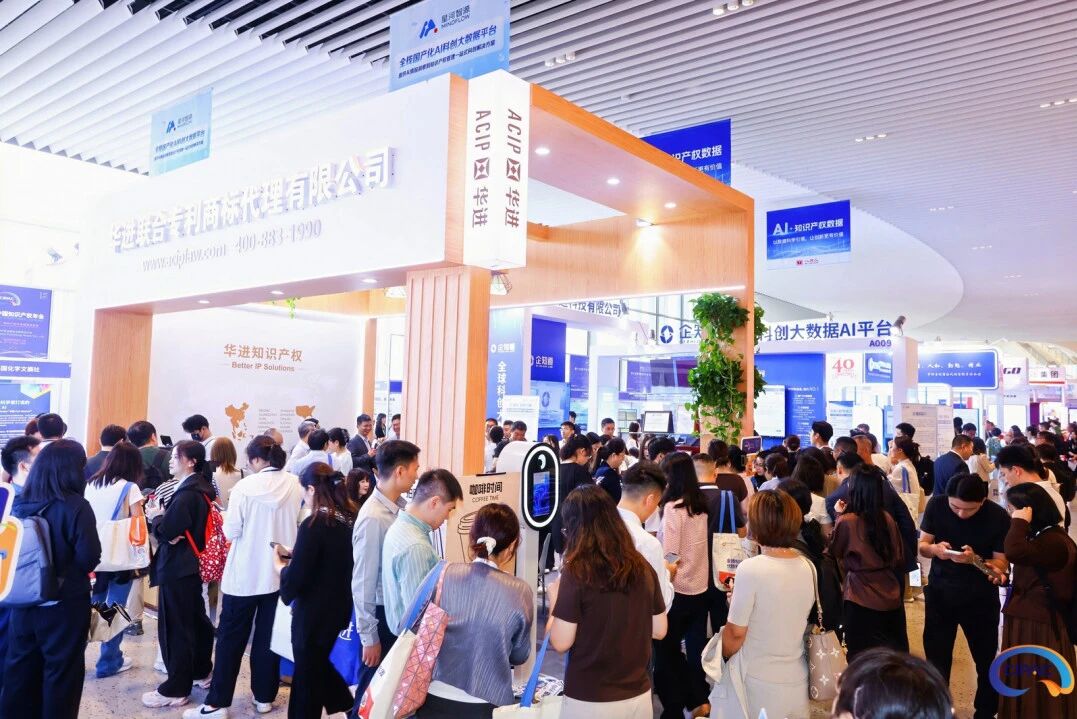
Here, ACIPsincerely thanks industry colleagues and partners for their years of attention,recognition and support for our professional team. We hope that in various IPexchange and interaction activities going forward, we can genuinely helpenterprises draw more strength through intellectual property, and we lookforward to ACIP's professional team bringing more collisions of ideas topractitioners in related fields.

